
Head Spa Osaka for TMJ and Jaw Tension After Long Flights

Twelve hours in economy, and somewhere over the Pacific your jaw started aching without you really noticing why.
You land in Osaka, and the first thing you register isn't the skyline.
It's a dull, tight soreness along your cheeks and temples.
Jaw clenched.
Shoulders up near your ears.
Classic long-haul posture.
Honestly, that's a strange souvenir to bring home from a flight.
Head Spa Osaka for TMJ and Jaw Tension After Long Flights is exactly what brought you here, and you are far from the only traveler typing that into a search bar at 2am, jet-lagged and rubbing their jaw.
Is it the altitude, the stress, or the hours of unconsciously clenching while you dozed upright against a headrest?
Probably some mix of all three, and the honest answer is that no single source gets to take the blame.
At Suimin Lab. in Osaka, we see this most often with guests who flew in from North America or Europe — long-haul routes where sleep happens in short, tense bursts rather than one real stretch.
A dry head spa session won't diagnose anything, but it is one of the more pleasant ways to unwind a jaw that's been locked tight for half a day.
If that sounds like relief you'd book right now, here's what's actually going on, and how a scalp and jaw-focused treatment fits into fixing it.
Let's get into why your jaw feels like it's been doing squats for ten hours, and what actually helps.
None of this is medical advice — think of it as a practical, traveler-level explanation plus a very relaxing option to try.
What's Really Causing That Clenched Jaw After You Land
Research on jaw clenching points mostly to stress, not altitude, as the biggest driver — and travel, let's be real, is stressful even when you're excited about the trip.
Your jaw muscles are unusually sensitive to tension, and plenty of people store stress there without realizing it until their face starts to ache.
If you're the type who grips armrests during turbulence or scrolls anxious travel threads at 3am, your jaw is probably picking up some of that tension too, even without you consciously clenching anything.
Add a cramped seat, a schedule that's fighting your body clock, and the kind of broken sleep where you clench your teeth instead of fully relaxing, and the soreness makes a lot more sense.
Cabin pressure changes can also strain the jaw joint directly, since it sits right next to the ear canal and can refer pain there during ascent and descent.
Poor posture plays a role too — hours spent hunched over a phone or a tiny seatback screen tend to drag your neck and jaw out of their natural alignment.
An economy seat that barely reclines, combined with a neck that's hunting for a comfortable angle for ten-plus hours, leaves the muscles around your jaw compensating in ways you don't notice until you're off the plane.
None of the research actually ties jet lag itself to jaw clenching, to be fair, but broken sleep is a well-documented trigger for nighttime teeth grinding, so the connection is real even if it's indirect.

Ear Pressure or TMJ? How to Tell the Difference
Not every ache after a flight is the same ache, so it's worth knowing which one you're dealing with.
Muffled hearing, popping, or a feeling of fullness in your ears usually points to pressure that hasn't equalized yet, which tends to settle on its own within a day.
A simple trick for next time is to yawn, swallow, or chew something during descent, which helps equalize that pressure before it builds into a headache.
Clicking when you open your mouth, tenderness around the jaw joint, or waking up with a sore jaw points more toward TMJ-type tension.
Most travelers land somewhere in the overlap — a bit of both, honestly — and a scalp and jaw massage can take the edge off either one even if it can't fix ear pressure directly.
Either way, a knot of tension sitting right next to your ear canal rarely improves on its own within the first day of a trip, so doing something about it sooner tends to pay off.
If the pain is severe, one-sided, or paired with dizziness or hearing loss, that's a conversation for a doctor, not a spa.

How a Dry Head Spa Session Targets Jaw and Scalp Tension
A dry head spa skips the shampoo and water entirely, which sounds unusual until you're actually in the chair and realize how much more it lets the therapist focus on pressure and technique instead of rinsing.
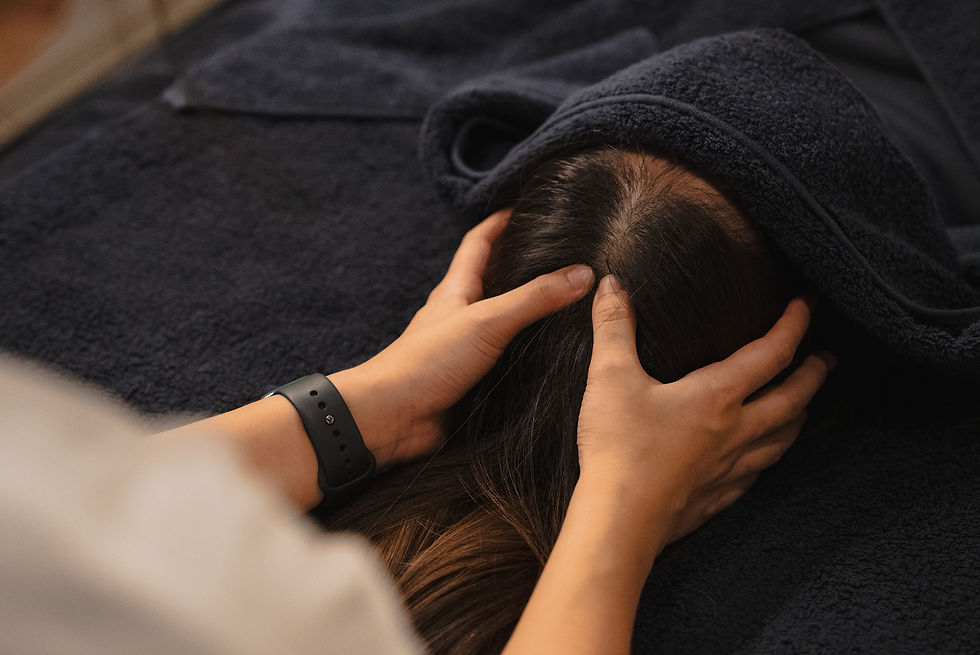
At Suimin Lab., sessions work the scalp, temples, and the muscles around the jawline with slow, deliberate pressure rather than anything quick or ticklish.
A typical session starts with a short conversation about where you're holding tension — jaw, temples, the base of your skull — so the therapist can adjust pressure to exactly where the day's flight did the most damage.
Many guests say the jaw-release portion is the part they didn't know they needed, right up until the therapist's thumb finds that one spot near your ear and the whole side of your face seems to drop an inch.
It's not a clinical treatment for TMJ, and we won't pretend otherwise, but as a self-care option for travel-related tension, it holds up well.
Think of it less like a dentist visit and more like someone finally convincing your jaw muscles that they're allowed to stop working for forty minutes.
Even a short layover visit can take the worst of the clench out of your jaw before you head to your hotel or straight back to the airport.
Easing Back Into Your Trip: Self-Care Before and After Your Visit
A few small habits make the recovery stick a little longer after you leave the chair.
An eye mask and a few slow breaths during the session help your whole nervous system catch up with the time zone, not just your jaw.
Drinking water rather than another coffee in the hours after your session also helps, since dehydration from the flight tends to make muscle tension linger longer than it needs to.
Afterward, try to avoid chewing gum or anything crunchy for the rest of the day — it gives the joint a genuine break instead of putting it straight back to work.
Gentle jaw stretches — opening slowly, side to side, nothing forced — can keep the looseness going for the rest of your day in Osaka.
If you're still adjusting to Osaka time, many business travelers already build a treatment like this into their itinerary between meetings, since the reset works just as well for a stiff neck as it does for a sore jaw.
And if you've only got a few hours before your next flight, it's worth comparing jaw tension to how we think about migraines and tension headaches — the same honest, no-promises approach applies.

Booking is simple, and the front desk team can talk you through options in English, Japanese, or Korean the moment you walk in.

Quick Booking Info
Price: ¥8,800 for 60 minutes; ¥27,000 for a couples course (90 minutes × 2)
Location: Okura Building 3F, 1-1-18 Miyakojima Hondori, Miyakojima-ku, Osaka — 5 minutes on foot from JR Sakuranomiya Station
Hours: 10:00–24:00 daily, reservation required
Languages: English, Japanese and Korean supported
Same-day slots: Sometimes available, never guaranteed — book ahead if your jaw can't wait
Booking: Reservation
Frequently Asked Questions
Q: Can a head spa actually treat TMJ?
A: No — it's a relaxation option for tension, not a substitute for a dentist if jaw pain is severe or persistent.
Q: How soon after landing should I book a session?
A: Anytime works, though many travelers go straight from the airport or on their first full day in Osaka.
Q: Will the therapist work directly on my jaw joint?
A: Yes, with gentle pressure around the jawline and temples as part of the scalp treatment, stopping short of any clinical manipulation.
Q: Is this safe if I also have ear pressure from the flight?
A: Generally yes, since the massage targets the scalp and jaw muscles rather than the ear — just mention any ear pain to your therapist first.
Q: Do I need to speak Japanese to book?
A: Not at all — the team at Suimin Lab. handles bookings in English, Japanese, and Korean.
Q: What if my jaw pain started before the flight, not because of it?
A: That's common too, and the same scalp and jaw treatment works just as well regardless of what triggered the tension.
For the complete picture, read our full guide to head spa Osaka.


Comments