
Hiking Recovery in Kansai: Can a Head Spa Help After Minoh, Ikoma or Koyasan?
Updated: 3 days ago

Why Hiking Recovery in Kansai Starts With Your Neck, Not Your Legs
You made it down the mountain, and your legs are fine.
It's your neck that feels like a bag of wet cement.
Your shoulders are somewhere up around your ears, and your jaw aches from a climb you barely remember clenching through.
Honestly, this is the part of a hiking trip nobody warns you about.
Now you're back in Osaka, searching for something that helps without wrecking tomorrow's plans.
This guide is about exactly that moment, and about what a dry head spa can and can't do for it.
What a Pack, Poles and Steep Steps Do to Your Upper Body
Think about what a hike actually asks of you.
Your head tilts forward to watch every step, sometimes for hours.
Pack straps press on your shoulders and the muscles at the base of your neck.
Poles keep your arms working, and steep climbs make you clench your jaw without noticing.
Outdoor recovery guides agree that this kind of tension is common, and that soreness tends to peak somewhere between 24 and 72 hours afterwards.
That delay is the trap, because you feel fine at dinner and stiff by the next morning.
Picture day three of a Kansai trip: 14 km on the trail, a 6 kg daypack, and a 7 a.m. train to Kyoto still waiting for you.
Sound familiar?
The classic fixes still apply: stretch gently, drink water, move a little the next day. For the tight, heavy feeling at the neck and head, our notes on shoulder tension after travel days go into more detail.
Kansai Trails That Leave You Sore, and How Close Osaka Is
Kansai is a great place to get tired on purpose.
The Minoh Falls trail in Minoo sits in the northern part of Osaka Prefecture and is an easy half-day out of the city.
Mt. Ikoma rises on the Osaka and Nara border, with steep stairs that punish the calves and the jaw in equal measure.
Koyasan in Wakayama and the longer Kumano Kodo routes take a full day or more.
All of them end the same way: a train back toward a city, and a body that wants to be looked after.
If you're based in Kyoto and pushing out to the hills, our comparison for Kyoto day-trippers choosing a head spa explains why Osaka can be the easier place to book after a hike.
Our salon is in Miyakojima Ward, a 5 minute walk from JR Sakuranomiya Station on the Osaka Loop Line.
That makes it a calm stop on the way back rather than a detour.

What a Dry Head Spa Actually Does After a Hike
A dry head spa means no water and no shampoo.
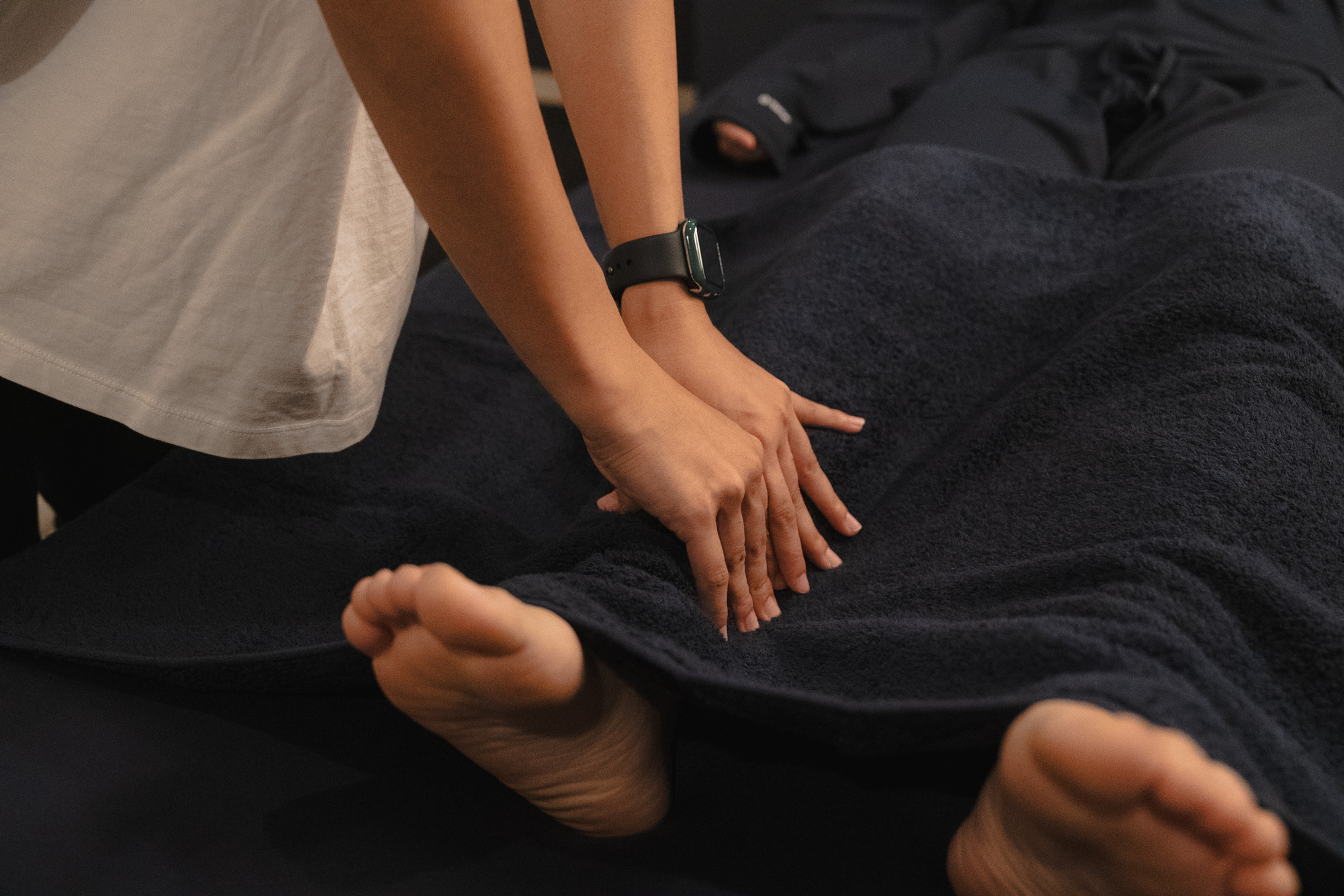
You stay dressed, lie back, and the therapist works the scalp, neck, shoulders and face with oil and slow, steady pressure.
Why does it suit a hiking day?
Because the muscles that hurt most, at the base of the skull, along the top of the shoulders and around the jaw, are exactly the ones that get attention.
You also skip the part many people dread after a long day: getting wet, drying hair and rearranging your evening.
Most guests tell us the first ten minutes are when the shoulders finally drop.
We can't promise that outcome, because every body is different, but the quiet room and the steady rhythm help.
It's also kind to tired travelers who can't face anything vigorous.

The Honest Limits: What It Can't Fix
Let's be straight about this.
A scalp and neck treatment is relaxation care, not medical treatment.
It won't repair a strained calf or a sprained ankle, and it isn't a replacement for stretching, food and sleep.
If you have sharp pain, numbness or tingling in your arms, or pain that keeps getting worse, please see a doctor first.
What it can do is ease the tight, heavy upper body feeling and give your nervous system a proper hour off.
That's why it pairs well with the basics of post-hike recovery rather than replacing them.
A good routine looks like this: water and a snack within an hour of finishing, a few gentle stretches, then the treatment later that evening or the next day.
Coming off a long flight as well as a long trail? Our guide to jet lag recovery in Osaka covers what to expect and what to skip.

How to Fit It In Without Wrecking Your Itinerary
Book the day you plan to hike, not the day after.
Evening slots work well for most people, since the salon is open from 10:00 to 24:00.
Same-day openings are sometimes available, but they're never guaranteed, so a reservation is the safe move.
Our staff speak English, Japanese and Korean, and the counseling before you start is where you mention the neck, the pack and the headache.
Tell us what hurts and we'll adjust the pressure.
Bring a small towel if you're coming straight off the trail, and don't worry about changing clothes first.
Prices start at ¥8,800 for 60 minutes, and a couples session of 90 minutes each is ¥27,000.

Quick Booking Info
Price: from ¥8,800 (60 min); couples 90 min ¥27,000
Address: Okura Building 3F, 1-1-18 Miyakojima Hondori, Miyakojima-ku, Osaka
Access: 5 min walk from JR Sakuranomiya Station
Hours: 10:00–24:00, reservation required
Languages: English, Japanese, Korean
Same-day: sometimes available, never guaranteed
Frequently Asked Questions
Should I book before or after the hike?
After. Book your slot for the evening of the hike or the following day, when the stiffness shows up.
Will a head spa help sore legs?
Not directly. It focuses on the scalp, neck, shoulders and face, so it eases the upper body tension from poles, packs and looking down at the trail.
Can I come straight from the trail in hiking clothes?
Yes. The treatment is dry and you stay dressed, so a quick wipe-down and a small towel are plenty.
Is it okay if I'm very tired or a bit sunburned?
Tell the therapist during counseling. We can lighten the pressure, and it's a good idea to skip anything on irritated skin.
Do you speak English?
Yes, our staff speak English, Japanese and Korean, so you can explain exactly where it hurts.
New to the idea? Start with our guide to what a Japanese head spa is, what it costs and how to book one.
For the complete picture, read our full guide to head spa Osaka.
Walk the trail, then give your head the hour it earned.
Comments